A weekend, a documentary, an intuition
After watching The Queen's Gambit some time ago, this weekend I saw a documentary about Judit Polgár — widely regarded as the greatest female chess player in history.
I'm not entirely sure why I watched it. Perhaps curiosity. Perhaps after weeks of thinking about AI, agents, and shifting systems — I simply needed to unwind.
But more than anything, that documentary reminded me of another pivotal story in modern chess history — one that occupied my mind for the rest of the weekend.
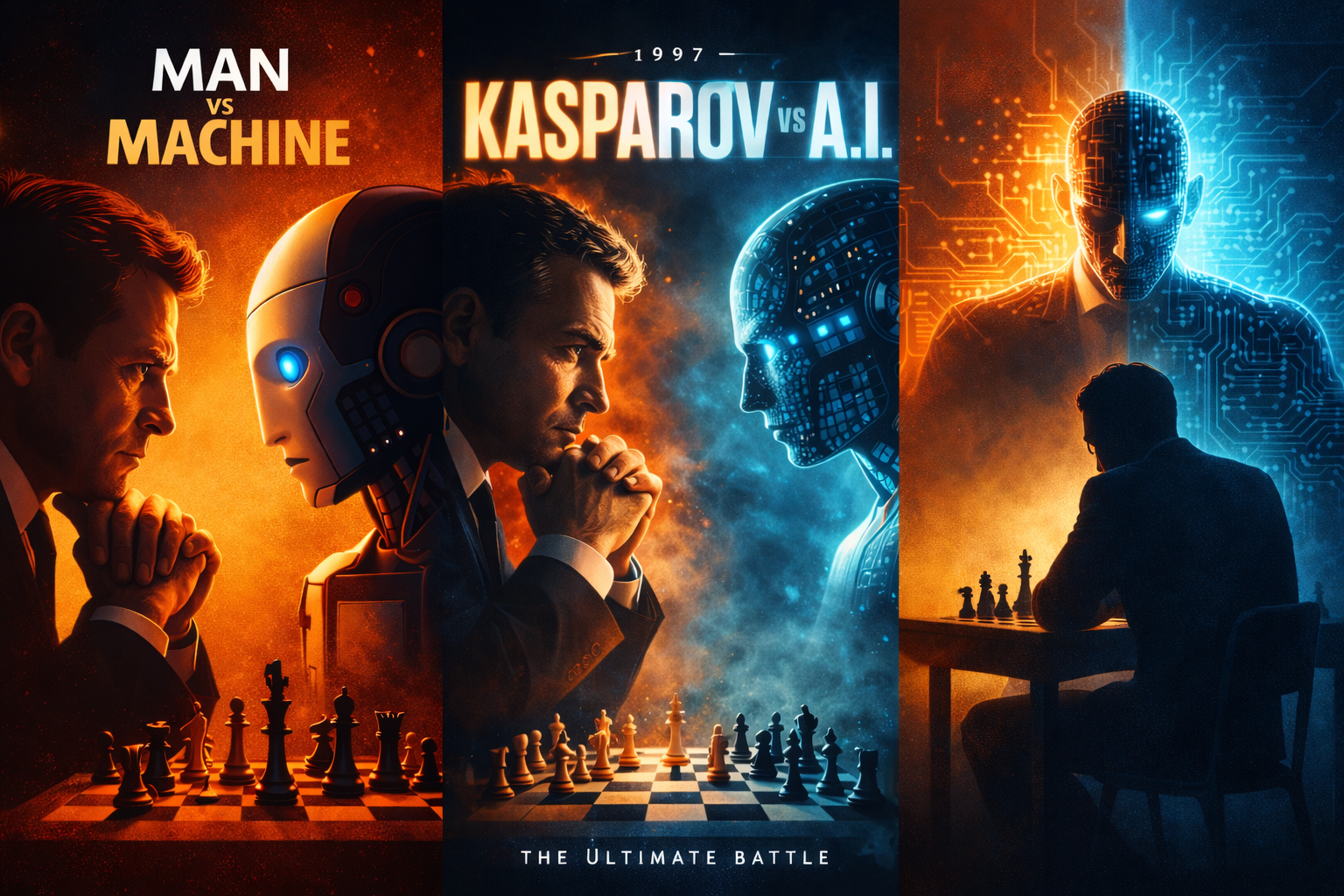
Looking into the history of modern chess afterward, I stumbled upon something I vaguely knew about but had never truly explored: the story of Kasparov versus Deep Blue. And what happened next.
Kasparov, Deep Blue, and the defeat that changed everything
His first reaction? He cries foul. Insinuates that humans are hiding behind the machine's moves. Refuses to accept what the game has just demonstrated.
What is striking, having just watched the documentary about Judit Polgár, is that this is exactly the same reaction. Whether facing Deep Blue or Polgár, Kasparov initially refuses to accept what the game has just proven.
It is a deeply human reaction.
But what happens next is far more interesting.
The invention of the centaur model
Rather than dwelling on his defeat against Deep Blue, Kasparov changes the question.
He no longer asks “how do I beat the machine?” He asks: “what happens if I play with it?”
Yet, surprisingly, they don't win.
The tournament is won by two American amateurs controlling three ordinary PCs simultaneously. Not the best humans. Not the best machines. The ones who understood how to orchestrate the collaboration between the two.
“A weak human player + machine + better process was superior to a strong computer alone and, more remarkably, superior to a strong human player + machine + inferior process.”
It is no longer a question of brute force. It is a question of method. Of interface. Of organization.
He goes even further. He argues that this model extends far beyond chess — from diagnostic medicine to industrial production. And he makes an observation that struck me:
In certain contexts, a pragmatic professional using an algorithm correctly can achieve better results than a brilliant expert who is reluctant to collaborate with the machine.
In other words: what holds back human-machine collaboration is not a lack of skill. It is sometimes an excess of expertise — and the reflex of wanting to have the last word.
The same transition, in our enterprises
Rereading this story over the weekend, I realized that we may be living through, in the enterprise world, exactly this same transition with AI agents.
For thirty years, we have designed information systems according to a clear logic: software executes, humans decide. Applications carry the business logic. Interfaces exist so that humans can interact with systems.
With the arrival of AI agents — capable of reading data, analyzing situations, proposing decisions, and triggering actions within systems — that boundary is shifting.
More and more often, it is no longer only humans who interact with systems. It is agents.
Some cry foul — “AI will replace everything, it's a threat.” Others get excited without grasping what it truly means to integrate these new actors into complex enterprise systems.
And the real question — the one it took Kasparov a few years to formulate after his defeat — is not “human versus machine.”
It is: how do we organize the collaboration between the two?
The centaur enterprise
His experience teaches us that the answer will come neither from the most technically advanced organizations, nor from the most talented human teams alone.
It will come from those who understand the rules of the new game — and build the systems, architectures, and governance frameworks capable of playing it.
As in chess twenty years ago, some see a confrontation: human versus machine. I believe that is the wrong reading.
The future looks much more like the centaur model from chess.
- Sets the objectives
- Understands the context
- Arbitrates decisions
- Bears the responsibility
- Explores possibilities
- Computes and optimizes
- Executes at scale
- Alerts on anomalies
Organizations where value comes neither from the best humans alone, nor from the most powerful machines alone. It comes from those who best know how to orchestrate the collaboration between the two.
What I take away from this
I watched a chess documentary to relax. I didn't expect to end the weekend with article drafts.
If my intuition is right, a new question is emerging for enterprises. Not just “how do we use AI?”
But: how do we design organizations — and information systems — capable of working with non-human intelligences?
Reflections to map a transition that is, I am convinced, one of the most profound I have witnessed in thirty years of information systems.
As in centaur tournaments, the advantage will go to those who understand the rules of the new game before everyone else.